Oltair collects and processes human data through a single multimodal instrument: self-report, speech, performance measures and passive sensor streams, in whatever combination a study, a team or an individual requires. It analyses them together — within a cohort and across cohorts — recognising behaviour loops and associations that remain invisible in any one dataset, for scientific research, performance optimisation and the monitoring of health and lifestyle. So that AI understands people better.
Verified identity is always stored separately from the data record — the only thing models and researchers ever see.
Identity is verified once at enrolment and held apart from everything that follows. Self-report, speech, cognitive performance and passive sensor streams accumulate against a single pseudonymous identifier; the models are fitted on the record and never see the person. That record is also the substrate for the work we are building towards — behaviour loops, health-relevant patterns inferred from concurrent passive streams.
Each cohort acquires as many modalities as its design requires.
Data protection is a property of the platform, not a setting per study. Identity verification, separate storage of the identity, pseudonymisation of the record, access bound to role and consent, and aggregation to the protocol before anything is released apply to every cohort, without exception.
An instrument for research institutions: recruitment by code or link, consent signed with Bank iD, instruments participants complete because they can answer by speaking, passive acquisition in between, and a protocol-scoped dataset at the end.
For research institutions →An instrument for teams of professionals — sport, physical performance, intellectual performance. Coaching and medical staff follow readiness and progress per member and analyse instrument, test and device data in one record, during the work and outside it.
Participation does not depend on remembering to open anything. The phone's own sensors are read passively and linked to the single identifier, giving a continuous behavioural substrate beside the instruments. From the concurrence of those streams we are building the recognition of behaviour loops — health-relevant patterns identified without a question being asked. On top of the passive stream sit the short exercises a participant chooses to run, such as the focus test.
Adherence fails where interaction is tedious. Instead of typing and tapping through screens, a participant asks for what they want and receives a spoken reply, dictates answers to an instrument, and asks what an item means as they would ask a person — which also removes a known source of measurement error. Spoken exchange is where we expect human–AI interaction to settle, and it is where this platform is built.
Focus, Vitality, Sleep — each on a 0–100 scale.Computed from instrument, test and device data, recalibrated as the record lengthens.
An individual baseline, not a population mean.The same value carries a different meaning for a 24-year-old midfielder and a 58-year-old study participant; the model resolves which.
Fitted on the data your study or team generates.Consented cohort data tunes the scoring and the assistant for that cohort. Nothing crosses a study boundary.
In development.Concurrent passive streams under one identifier define a loop; the research direction is to establish which loops carry health and performance signal, at a resolution that improves as cohorts accumulate.
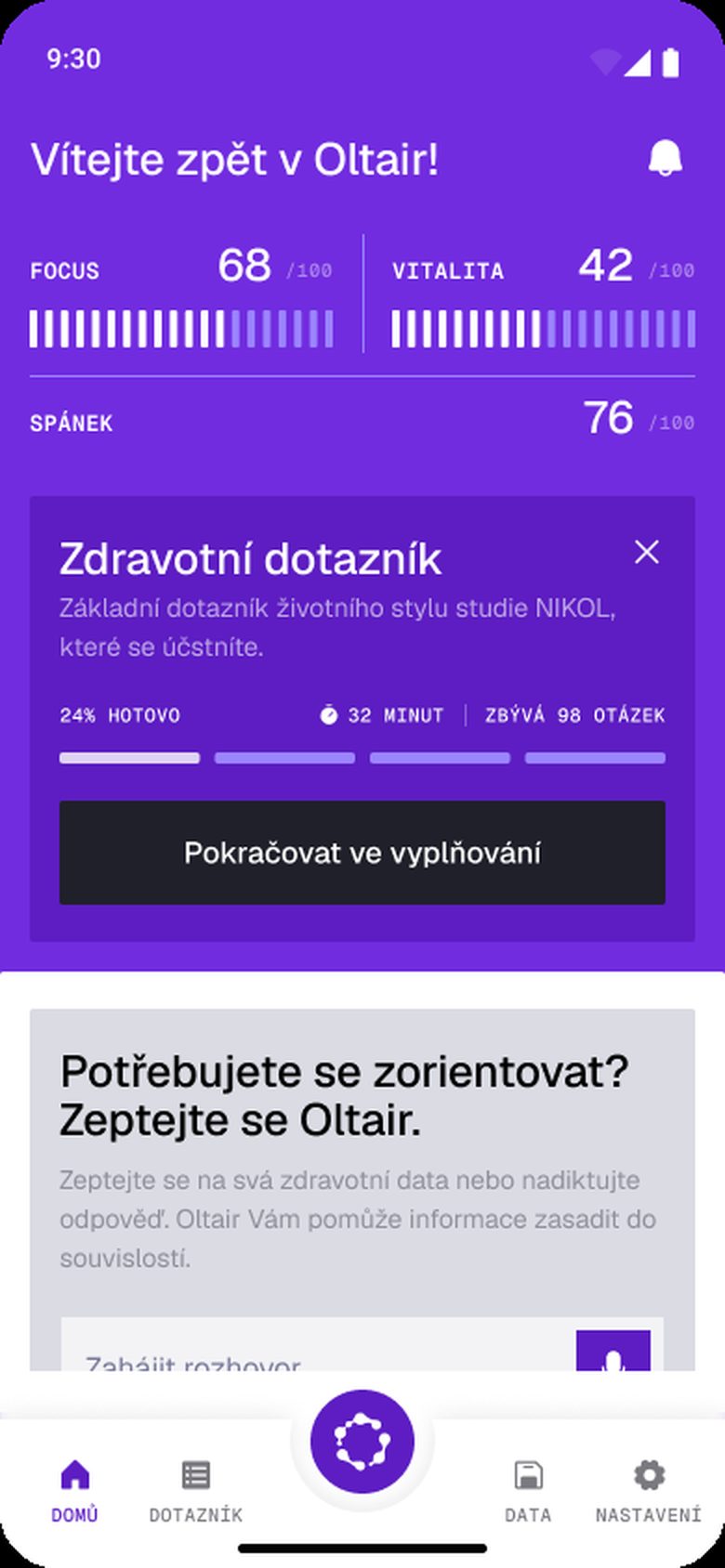 Oltair app · home screen
Every input lands in the same pseudonymous record. Beneath the instruments run the phone's own sensors, read continuously and without action from the participant.
Read in the background and linked to the one identifier — a continuous behavioural substrate beside the instruments.
PassiveA 185-item intake instrument in modules — sleep, home and daylight, movement, nutrition, mood — completed across days, resumed on any device, by tap or by voice.
LiveVerbal variables: what a participant says when asked, transcribed and structured into the record.
LiveA focus test as the first in-app measurement: five valid rounds, the day's mean against the preceding night's sleep. Further tests follow the same pattern.
LiveThe dialogue itself — questions, dictated answers, requests for clarification — as a stream of its own.
LiveHeart-rate variability, strain, sleep staging and recovery from the device a participant already wears.
LiveBiomarker panels attached to the record through the study partner, under the study consent.
AddingGenetic profiles joined to the record where a protocol calls for them.
AddingFood products and daily-use items, photographed and recognised — an image in place of a diary.
AddingWe hold to the standards of medical research — informed consent, strict separation of the person from the data, aggregation before anything is released — and make the acquisition continuous, interactive and easy to stay with. The standard is not relaxed to make that possible.
Identity is verified through the participant's own bank and the consent is signed the same way, with a qualified timestamp. No paper, no scanned signature, no ambiguity about who consented.
Identity is held in one system under its own access control, the record in another. Models, analysts and exports see a pseudonymous record. Individual-level data never leaves the platform.
Several controls separate individual data from study data. What leaves is aggregated, and it is published or destroyed as each protocol requires.
Set up a study or a team, invite participants by code, follow the acquisition as it arrives, export to the protocol and tune the models on your own data. Administrators sign in here.
 oltair